
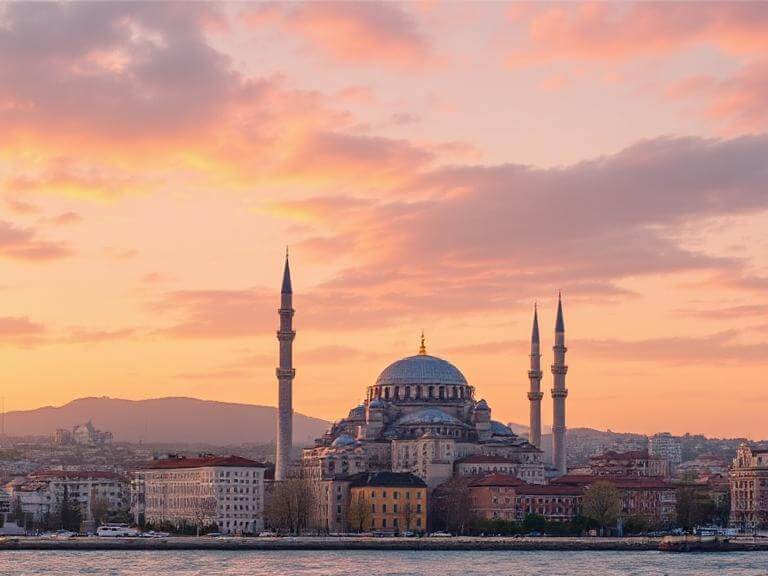
Turkey today is no longer just a bridge between continents, it has become a global economic hub driven by rapid development and construction. With the significant transformation in its real estate market, investing in Turkey has emerged as a strategic opportunity not to be missed, supported by modern infrastructure, high investment returns, and a cultural environment familiar and comfortable to Arab investors, making it an ideal destination for both living and investing.
This article serves as your comprehensive guide to understanding the key reasons and opportunities that answer one crucial question: Why is Turkey your next investment destination in 2026?
Advantages of Investing in Turkey
Investing in Turkey in 2026 is one of the top recommendations made by real estate consultants, thanks to a range of compelling advantages outlined below.
Turkey’s Strategic Location
Turkey enjoys a unique geographical position, lying partly in Asia and partly in Europe, which makes it a natural bridge connecting the two continents. It sits at the crossroads of the Balkans, the Caucasus, the Middle East, and the Eastern Mediterranean.
The country is bordered by the Black Sea to the north, Georgia and Armenia to the northeast, Azerbaijan and Iran to the east, Iraq and Syria to the southeast, the Mediterranean Sea and the Aegean Sea to the south and west, and Greece and Bulgaria to the northwest.
While Ankara serves as the capital, Istanbul stands as the nation’s largest city and its most important port. This distinctive positioning has made Turkey a vital center for trade, culture, and investment, and one of the world’s most dynamic real estate markets, combining both European sophistication and Eastern character.
A Diverse and Growing Economy
Turkey’s economy stands out for its flexibility and the diversity of its sectors, ranging from advanced industries to thriving trade and tourism. The Turkish economy grew by 4.8% in the second quarter of 2025, and growth is expected to continue thanks to the rise in exports and strong government incentives for foreign investment, which together reinforce long-term economic stability.
In the first quarter of 2025, Turkey’s GDP increased by 2%, the construction sector expanded by 7.3%, and real estate activities grew by 2.4%, alongside positive performance across several other sectors.
Advanced Infrastructure
The Turkish government has heavily invested in infrastructure, including massive airports such as Istanbul New Airport, modern railway networks, and advanced ports. Notably, Istanbul Atatürk Airport ranked as the 10th busiest airport in the world and the 5th busiest in Europe.
These developments not only facilitate trade and transportation but also significantly increase property values in the surrounding areas.
Government Incentives for Investors
To attract foreign capital, the Turkish government offers a wide range of unprecedented incentives, including tax exemptions and simplified administrative procedures, especially in industrial zones and strategic projects. Key benefits include:
- Tax reductions and exemptions for new projects, along with simplified company registration procedures.
- Exemption from VAT on land purchases and property tax exemptions for up to five years for industrial developments.
Obtaining Turkish Citizenship through Investment
Investors can obtain Turkish citizenship through real estate investment by purchasing property worth at least USD 400,000 and maintaining ownership for a minimum of three years. This path offers several key advantages:
- Citizenship for the investor and eligible family members (spouse and children under 18 years old).
- The ability to rent out the property and generate attractive annual rental income.
- No requirement for physical residence in Turkey before, during, or after obtaining citizenship and the Turkish passport.
- Eligibility to apply for the U.S. E2 Investor Visa after acquiring Turkish citizenship.
- Easier access to the Turkish job market and local educational institutions.
- Benefit from the Customs Union Agreement between Turkey and the European Union, allowing trade advantages despite Turkey not being an EU member.
Real Estate Investment Opportunities in Turkey
The real estate sector remains the backbone of foreign investment in Turkey, and the opportunities projected for 2025 and beyond are highly promising, particularly with the continued rise in residential and tourism-related demand.
Turkish law allows investors to freely transfer profits from real estate and other investments abroad within a structured legal framework that safeguards their rights and strengthens investor confidence.
Real Estate Market Performance in Turkey vs. European Countries
According to multiple studies comparing property markets between Turkey and European nations—based on factors such as average property prices, cost per square meter, and annual growth rates—the following table summarizes the key figures:
| Country | Average Price per Square Meter | Return on Investment | Annual Growth in Property Value |
| Turkey | Recorded an annual increase of 32.2% in nominal terms and a 0.8% decrease in real terms | Approximately 7.76% (for residential units in 2025) | Around +22.40% (nationwide in 2025, in Turkish lira) |
| European Countries | In Q2 2025, residential property prices rose by 5.1% in the Euro area and 5.4% in the EU, compared to the same quarter of the previous year | Between 3% – 5%, marked by currency stability and purchasing power | Property prices increased by 5.1% in the Euro area and 5.4% in the EU in Q2 2025 vs. Q2 2024 |
Best Cities for Real Estate Investment in Turkey
Here are the top cities offering the most promising real estate investment opportunities across Turkey:
Istanbul
Istanbul is one of the leading destinations for real estate investment in Turkey, having recorded a remarkable 33.5% increase in property prices. The average unit price has reached approximately 63,125 TRY (~USD 1,630) per square meter, while rental yields average around 8.15%.
Notably, Istanbul ranks first among all Turkish provinces in terms of the number of properties sold to foreign investors, accounting for 38% of total foreign sales nationwide.
Adana
Adana stands out as one of Turkey’s fastest-growing real estate markets, with property prices increasing by 42.9% year-on-year and achieving the highest rental yield in the country at 8.87%. Its affordability, industrial activity, and growing population make it an appealing city for both residential and investment purposes.
Ankara
The capital city, Ankara, is another top performer in Turkey’s real estate sector, showing a 45.9% annual growth in property prices and an average rental yield of 8.67%. Its stable economy, government institutions, and demand for long-term rentals make it a strong and balanced investment choice.
Challenges and Drawbacks of Investing in Turkey
While Turkey offers a wide range of investment opportunities, it also faces certain challenges. However, the government has taken clear and practical measures to address them, as outlined below:
Economic Fluctuations
In response to inflationary pressures, the Central Bank raised interest rates to 50% in 2024 and launched a Medium-Term Program (2025–2027) aimed at stabilizing inflation, restoring market confidence, and strengthening the Turkish lira through structural fiscal reforms.
Changing Laws and Regulations
To simplify administrative procedures and reduce bureaucracy, the government established the Coordination Council for the Improvement of the Investment Environment (YOIKK) and introduced the 2024–2025 Business Facilitation Plan, which includes faster licensing processes and a unified digital window for investors.
Alignment with European Union Standards
Turkey has updated its regulations on data protection, cybersecurity, and commercial arbitration to align with EU legal standards, reducing compliance risks and increasing investor confidence.
Environmental Policies
The government has promoted the green transition through renewable energy projects, allocation of land for clean energy production, and preparations for implementing a national carbon trading system.
Financial Risks
Turkey has strengthened cooperation with the International Finance Corporation (IFC) to provide long-term financing solutions and support green bonds and sustainable projects, enhancing the overall resilience of the economy.
As highlighted throughout this guide, Turkey stands out as an investment destination with a diverse economy, a strategic location connecting Asia and Europe, and a real estate market driven by both local and international demand. It is no surprise that Turkey is projected to be among the most attractive investment markets in 2026.
Whether you are seeking stable returns, second citizenship, or long-term capital appreciation, Turkey offers the ideal mix of opportunity and growth.
Get in touch with us today to explore the best real estate investment opportunities available and start building your portfolio in Turkey.
Frequently Asked Questions
Why invest in Turkey?
Because it offers a strategic location connecting Europe and Asia, a diversified economy, advanced infrastructure, strong rental yields, and attractive government incentives.
Is investing in Turkey safe?
Yes, modern Turkish laws protect foreign investors and guarantee full ownership rights and the free transfer of profits.
Does purchasing real estate grant Turkish citizenship?
Yes, investors can obtain Turkish citizenship by purchasing property worth at least USD 400,000 under the current regulations.
What are the key benefits of real estate investment in Turkey?
Competitive prices, strong rental returns, easy resale, eligibility for citizenship, and an active market supported by tourism and domestic demand.
Which cities are best for real estate investment in Turkey?
Istanbul, Antalya, Trabzon, and Ankara — with Istanbul leading as the most attractive destination due to continuous demand and rapid urban development.